

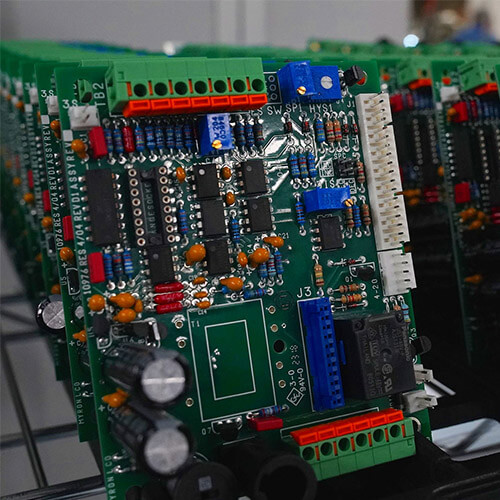
IT180A Laminate: Data Sheet Values and PCB Design Checks
IT180A (ITEQ IT-180A) is a high-Tg, low-CTE, filled-epoxy PCB laminate with published thermal and frequency-dependent dielectric data. Designers often search for an IT180A data sheet to evaluate lead-free assembly, plated-hole reliability and controlled-impedance routing. This guide extracts representative manufacturer values and turns them into a practical material-selection checklist. Verify the current revision and the actual core/prepreg construction before releasing a board.
IT180A data sheet: thermal and dielectric values
ITEQ’s IT-180A data sheet, revision 030411, gives a typical glass transition temperature (Tg, DSC) of 180°C and a 170°C minimum specification. Typical decomposition temperature (Td, 5% mass loss) is 350°C, with a 340°C minimum. Typical in-plane CTE from 40°C to 125°C is 10–13 ppm/°C. The typical Z-axis CTE is 45 ppm/°C below Tg and 210 ppm/°C above Tg; typical Z-axis expansion from 50°C to 260°C is 2.7%. These numbers help assess thermal mismatch between the dielectric and plated copper, but they do not predict finished-board reliability by themselves.
For copper-removed laminate samples, the sheet lists typical T260 greater than 60 minutes and T288 greater than 30 minutes. It also reports typical moisture absorption no higher than 0.12%. Temperature ratings, test methods and acceptance specifications should be read together; Tg is not the same as a continuous operating-temperature limit.
At 50% resin content, typical IT180A dielectric constant is 4.4 at 1 GHz and 4.1 at 10 GHz. Typical loss tangent (Df) is 0.015 at 1 GHz and 0.016 at 10 GHz. The sheet distinguishes test methods: HP4291B at 1 GHz and resonant-cavity measurements at 10 GHz. Because glass style, resin content, copper roughness and frequency affect real transmission lines, use these published figures for material screening, then request a construction-specific impedance and loss model.
When is IT180A a sensible choice?
IT180A PCB laminate is a candidate for multilayer boards that must tolerate lead-free assembly heat and need controlled through-thickness expansion. It may suit dense plated-through-hole layouts, network or industrial electronics and other boards whose stackup and thermal profile justify a high-Tg material. Selection still requires validation of finished thickness, copper weight, drilling, plating and assembly conditions.
High Tg does not automatically mean low RF loss. At microwave frequencies, evaluate the channel’s insertion-loss budget against the published Df, copper surface and trace length. A different low-loss laminate may be more appropriate if attenuation dominates. Review high-frequency PCB options and PCB material selection when comparing alternatives.
5 checks for an IT180A multilayer stackup
- Lock the exact construction. List each core and prepreg, glass style, resin content, dielectric thickness, copper weight and finished board thickness. State whether substitutions are allowed.
- Calculate impedance with the right Dk. Provide operating frequency, target impedance, reference layers and tolerance. The data sheet’s 1 GHz value is not a universal value for every build.
- Review via stress. Supply board thickness, finished hole size, aspect ratio, via density and expected thermal cycles. Ask for the fabricator’s plating and microsection acceptance plan.
- Define assembly exposure. Share peak reflow temperature, number of cycles, rework steps and storage conditions. Compare them with the approved process window.
- Agree on evidence. Specify IPC class, impedance coupons, material certificates and any product-specific reliability tests required by the customer.
For an actual design, copper balance, lamination and drilling choices influence the benefit obtained from the laminate. KKPCB’s multilayer PCB page explains the broader manufacturing context. If you are evaluating a closely named material, see the separate IT180ATC guide; do not assume the two designations share the same electrical table or purchasing specification.
IT180A FAQ
Is IT180A equivalent to IT180ATC?
Do not assume equivalence from the similar names. Confirm the manufacturer’s current product designation, construction, data sheet revision and approved substitution rules for your build.
Can the 10 GHz Dk value be used for every stackup?
No. The published 4.1 is a typical test result at 50% resin content. Ask the fabricator for the value or model applicable to the chosen dielectric construction.
Does 180°C Tg guarantee survival through multiple reflows?
No. Reflow performance also depends on moisture, material condition, board geometry and the precise thermal profile. Qualify the finished board and assembly process.
Request an IT180A material review
Send your fabrication data, layer stack, copper and finished-hole requirements, impedance targets, assembly profile, quantity and application to KKPCB’s RFQ page. Request confirmation of IT180A availability, the current manufacturer revision and any proposed substitution before production approval.
Technical source: ITEQ IT-180A manufacturer data sheet (Rev. 030411). Values are reference data; the agreed purchase specification governs the actual material supplied.
